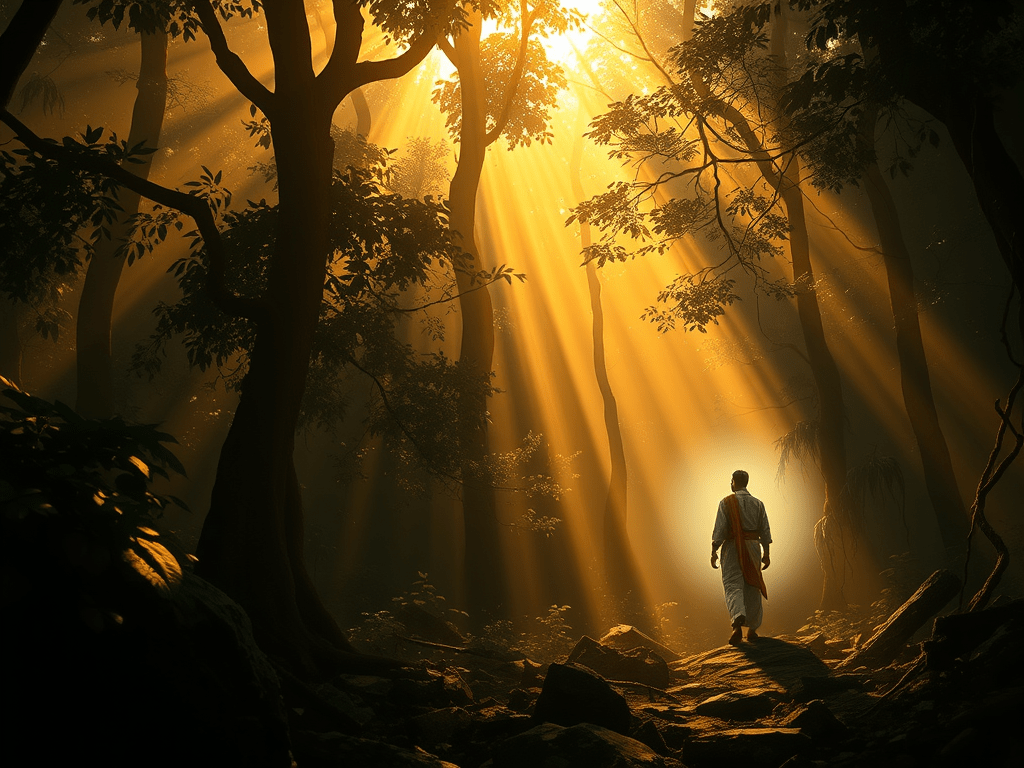
How a highway robber became the sage who gave the world its greatest epic
Most Indians have grown up with the Ramayana woven into the fabric of their consciousness. Whether through the mesmerizing television series of the 1980s that brought entire neighborhoods to a standstill, through bedtime stories whispered by grandparents, or through the countless retellings that echo through our temples and homes, the tale of Rama has become our collective heartbeat.
But have you ever wondered about the extraordinary story behind the story? About how this timeless epic came to be penned by a man who began his journey as a common criminal? The origin of the Ramayana itself reads like an epic—a tale of transformation so profound it seems almost mythical.
The Bandit in the Forest
Picture, if you will, the dense forests of ancient India, where sunlight barely penetrated the thick canopy above. Through these shadowy paths, a desperate man named Ratnakar lurked, waiting for unsuspecting travelers. Driven not by greed but by the gnawing hunger of his family during a terrible famine, he had chosen the darkest of paths—highway robbery.
Ratnakar was no ordinary criminal. Despite his circumstances, there burned within him a fierce devotion to his family. Every coin he stole, every traveler he robbed, he justified as his sacred duty as a provider. In his mind, he was not a thief but a desperate father and husband, doing whatever it took to keep his loved ones alive.
His family, safely tucked away in their humble dwelling, knew nothing of his shameful profession. They accepted the food and money he brought home with grateful hearts, never questioning its dark origins.
The Encounter That Changed Everything
One fateful day, as golden rays of the setting sun filtered through the ancient trees, a group of learned men made their way through Ratnakar’s hunting ground. These were no ordinary travelers—they carried themselves with the serene confidence of those who had touched the divine. Leading them was the great sage Narada, whose very presence seemed to illuminate the forest path.
When Ratnakar leaped from the shadows, brandishing his weapons and demanding their valuables, the sages showed no fear. Instead, they looked upon him with eyes full of compassion and curiosity.
“Tell us, young man,” Narada’s voice was gentle as a summer breeze, “why do you choose this path of darkness?”
“To feed my family!” Ratnakar replied with fierce pride. “It is my dharma to care for those who depend on me.”
The sage’s eyes twinkled with ancient wisdom. “Ah, but what of the karma you accumulate through these actions? The weight of sin you carry—will your beloved family share this burden with you?”
Ratnakar’s chest swelled with confidence. “Of course they will! We share everything—joy, sorrow, prosperity, and hardship. They will surely share my karma as well.”
“Then go,” Narada said softly, “ask them. We shall wait here under these very trees until you return.”
The Shattering Truth
Racing through the forest with the urgency of a man seeking validation for his life’s choices, Ratnakar burst into his home. With desperate hope, he posed the question to his wife, his children, his aging parents.
The response shattered his world like a clay pot dropped on stone.
“We share your earnings, dear one, and we share your love,” his wife said gently, “but your karma? No, that burden is yours alone to bear.”
His children nodded in innocent agreement. His parents, though grateful for his care, could not bring themselves to accept responsibility for sins they had not committed.
The walk back to the waiting sages felt like a journey through the underworld. Each step carried the weight of terrible realization—he had damned himself for people who would not share his damnation. His love had blinded him to a cruel truth: karma is intensely personal.
The Birth of a Seeker
When Ratnakar returned, broken and hollow-eyed, Narada was waiting with the patience of eternity itself.
“I see the truth has found you,” the sage said with infinite compassion. “But all is not lost. There is a path to redemption, a way to transform this darkness into light.”
From the folds of his simple robes, Narada produced no magic charm or sacred amulet—only two simple syllables that would change the course of spiritual history.
“Chant ‘Ra’ and ‘Ma,'” the sage instructed. “Let these sacred sounds align your heart chakra with your crown chakra. Let them wash away the stains of your past and reveal the luminous being you truly are.”
With nothing left to lose and everything to gain, Ratnakar accepted the sacred mantra. He found a quiet spot in the forest, assumed a meditative posture, and began to chant.
“Ra… Ma… Ra… Ma…”
The Miraculous Transformation
What happened next defies the boundaries of ordinary human experience. As Ratnakar chanted, he entered a state of meditation so profound that the external world ceased to exist. Days turned to weeks, weeks to months, months to seasons.
His body, motionless as a statue carved from the very earth, became one with the forest. Termites, perhaps mistaking him for a fallen log, began to build their hill around him. Vines grew over his limbs. Small creatures made nests in the folds of his clothing. Still, he chanted.
“Ra… Ma… Ra… Ma…”
Years passed in this transcendent state until the day sage Narada returned to that very spot. Hearing the familiar sound of divine chanting, he followed the melodious vibration to its source. What he found was extraordinary—a large anthill from which emerged the pure sound of “Rama.”
With careful reverence, Narada began to break away the earthen structure. What emerged was not the desperate bandit who had once threatened travelers, but a luminous being whose very presence radiated peace and wisdom. The criminal Ratnakar was dead; in his place sat an enlightened sage.
“You shall be known as Valmiki,” Narada declared, “he who emerged from the anthill (valmika). You have been reborn not of flesh and blood, but of divine sound and sacred transformation.”
The Hermitage by the Tamasa
The newly christened Valmiki established his ashrama on the banks of the gentle Tamasa River, where the waters sang soft lullabies and the trees offered their shade like benedictions. Here, in this sanctuary of peace, he lived the life of a true ascetic, his days filled with meditation, contemplation, and service to any seeker who found their way to his humble dwelling.
Sage Narada became his frequent visitor and guide, sharing profound wisdom and cosmic stories during their long conversations under the starlit sky.
The Moment of Poetic Birth
One morning, as Valmiki walked along the riverbank for his daily ablutions, he was struck by a scene of pure, transcendent beauty. High above the gently flowing waters, a pair of cranes danced in the golden air, their movements a symphony of grace and devotion. Their love was so palpable it seemed to sanctify the very atmosphere.
Valmiki paused, his heart filled with the same divine love that animated the dancing birds. In that perfect moment, nature seemed to hold its breath in reverence for pure, untainted affection.
Then, like a bolt of lightning splitting the peaceful sky, an arrow whistled through the air.
Thud.
The male crane plummeted to the earth, landing at Valmiki’s feet in a spreading pool of crimson. Above, his mate’s cry of anguish pierced the morning stillness—a sound so heartbroken that it seemed to tear the fabric of creation itself. Unable to bear the separation, the female bird ceased her flight and fell dead beside her beloved.
The transformation in Valmiki was instantaneous and volcanic. The sage who had found perfect peace was suddenly consumed by righteous fury. Words erupted from his lips—not the measured speech of a holy man, but the anguished cry of a heart that could not bear injustice:
मा निषाद प्रतिष्ठां त्वमगमश्शाश्वतीस्समा: ।
यत्क्रौञ्चमिथुनादेकमवधी: काममोहितम् ।।
“O hunter, since you have killed one of this pair of cranes lost in love, may you find no rest for eternity!”
As the words left his lips, Valmiki paused in wonder. The curse had emerged not in ordinary speech, but in perfect meter—a new form of expression that seemed to contain within its rhythm the very heartbeat of the universe. Each syllable carried weight beyond meaning; the verse itself seemed alive.
When Narada arrived later that day, he found Valmiki staring at the spot where the cranes had fallen, still marveling at what had emerged from his anguish.
“What you have created,” the divine sage said with excitement barely contained within his serene demeanor, “is something entirely new. This rhythmic expression—this poetry—it has the power to carry truth in a way that ordinary words cannot. You must continue with this gift.”
The Commission of a Lifetime
But Valmiki was puzzled. “What story could possibly be worthy of such expression? What tale deserves to be told in this new form of verse?”
Narada’s eyes lit up with the joy of a cosmic storyteller about to share the greatest tale ever conceived. “Do you remember the sacred syllables that transformed your life? ‘Ra’ and ‘Ma’? There lives a king named Rama in the great city of Ayodhya whose story encompasses every human emotion, every divine principle, every truth worth preserving for future generations.”
Settling cross-legged on the soft grass, Narada began to weave the epic tale: A prince of unmatched virtue exiled to the forest for fourteen years to honor his father’s promise to a manipulative stepmother. A devoted wife who chose to share her husband’s hardships. A demon king whose hubris led him to abduct the princess, setting in motion a cosmic war between good and evil. An unlikely army of forest dwellers who helped the exiled prince reclaim his beloved and restore dharma to the world.
As Narada spoke, Valmiki felt the stirrings of divine inspiration. Here was a story that contained within it every human struggle, every moral complexity, every triumph and tragedy that had ever been or ever would be. This was the tale worthy of his newfound gift of verse.
“I shall tell this story,” Valmiki declared, “but not as it was, but as it should be remembered—in verses that will carry its truth across the ages.”
When Life Imitates Art
And so began the composition of the Ramayana. Day after day, Valmiki crafted verse after perfect verse, bringing to life characters he had never met, describing places he had never seen, capturing emotions he channeled from the very essence of human experience.
The sage was so absorbed in his work that months passed like days. He was putting the finishing touches on Sita’s exile when one morning, while collecting fruits and flowers for his daily offerings, he heard the soft sound of weeping from beneath a massive banyan tree.
There, with one hand pressed to her swollen belly and tears streaming down her face, sat a woman whose beauty seemed to glow with inner light despite her obvious distress. Everything about her—the grace of her posture even in sorrow, the nobility written in her features, the way she seemed to radiate virtue like a subtle fragrance—struck Valmiki with startling recognition.
This was Sita. Not the character from his epic, but Sita herself—the very princess whose story he had been writing, now cast out and alone, carrying within her womb the future of the Raghu dynasty.
The circle of destiny had completed itself in the most extraordinary way imaginable. The sage who had gained enlightenment through chanting Rama’s name, who had been inspired to write Rama’s story, now found himself caring for Rama’s beloved wife.
The Living Epic
Valmiki welcomed Sita into his ashrama with the tenderness of a father and the reverence due to a goddess. Under his protection, she gave birth to twin sons—Lava and Kusha—who grew up hearing their own story told back to them in their foster grandfather’s magnificent verses.
Imagine the cosmic irony: Valmiki had written an epic about characters he thought were distant figures, only to discover that he was actually documenting events that were unfolding in real time. The story he thought he was creating was actually creating itself around him.
As the boys grew, they became not just the inheritors of their father’s legacy but also the first performers of their own story. Under Valmiki’s guidance, they mastered the art of storytelling, their young voices carrying the epic verses to courts and festivals across the land.
When they finally sang their story in their father Rama’s own court—not knowing they were singing to the very hero of their tale—destiny reached its perfect culmination. The epic that began with a bandit’s transformation completed its circle with a father’s recognition of the sons he had never known.
The Eternal Teaching
The story of Valmiki reminds us that transformation is not just possible but inevitable for those who surrender to divine grace. A man who began by taking from others ended by giving the world its most treasured spiritual treasure. A criminal became a creator. A destroyer of peace became a weaver of immortal verses that have brought peace to millions of hearts across millennia.
The Ramayana itself—born from a curse that became a blessing, written by a sage who lived the very story he told—stands as proof that the most profound truths often come from the most unexpected sources.
In our modern age, when we feel disconnected from the sacred stories that once guided humanity, perhaps we need to remember that the Ramayana was never meant to be just ancient history. It is a living document, born from lived experience, meant to be experienced anew by each generation that encounters its verses.
The next time you read or hear the Ramayana, remember Valmiki—the transformed bandit who gave us an eternal gift. Remember that his story teaches us the most hopeful truth of all: no matter how far we have fallen, no matter how dark our past, the light of transformation is always just two syllables away.
Ra… Ma…
The sacred sound that changed a criminal into a saint, that turned sorrow into song, that transformed a curse into the world’s most beloved blessing.
The magic is still there, waiting for anyone brave enough to begin.
What aspects of Valmiki’s transformation resonate most deeply with you? Share your thoughts on how this ancient story of redemption speaks to our modern quest for meaning and transformation.
 Life as Sakti
Very nicely explained! Read it one stretch!
very nice!