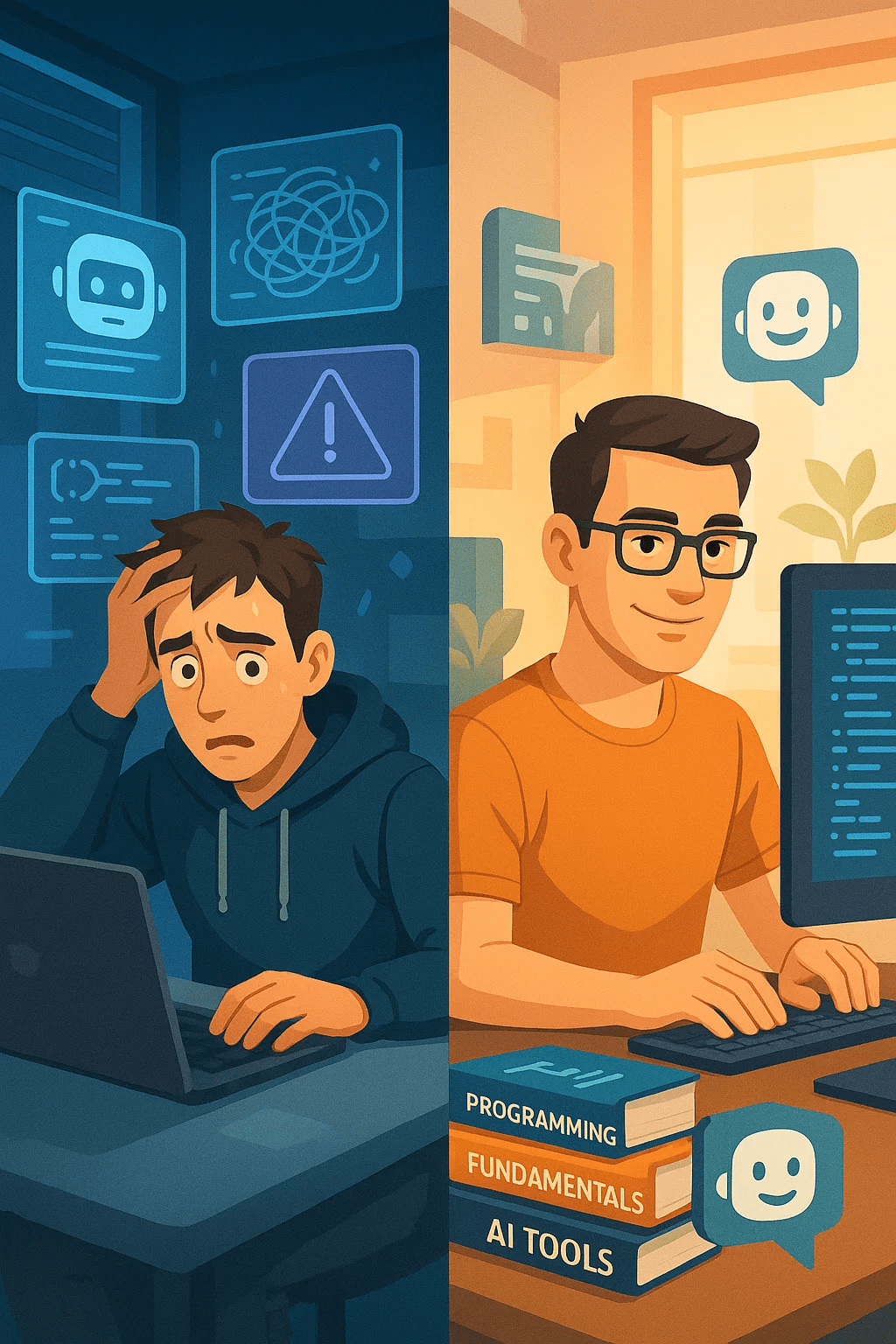
Chapter 1: The Ninja of Interviews
Chad GPT-Prompt (yes, he changed his last name to sound “AI-forward” legally) is a new graduate of the well-known Institute of Theoretical Button-Clicking. Chad had learned the old art of getting ready for an interview with the same level of commitment as a monk studying holy books. His browser bookmarks were like a greatest hits album: “Top 50 Java Questions,” “Behavioral Interview Hacks,” and “How to Sound Smart When You Don’t Know Anything.”
Chad’s plan for getting ready was perfect in its simplicity:
Technical Questions: Learn the answers by heart without really getting the ideas.
Coding Problems: Keep working on the problems on LeetCode until you get them right.
Learn terms like “microservices,” “scalability,” and “distributed systems” (you don’t have to say them out loud).
“Why learn when I can just look it up on Google?” Chad would talk to his mirror every morning to practice his confident smile. “AI will also do all the hard work.” “I’m just the engineer for the prompt!”
The Golden Ticket is Chapter 2.
Chad got the job at MegaCorp International, even though it didn’t make sense and didn’t seem possible. The interviewer liked how confidently he read his prepared answers and how excitedly he said, “AI is the future, and I’m riding the wave!”
Chad’s parents threw a party to celebrate. “Our son, the software engineer!” they said with big smiles as they posted updates on LinkedIn with crying-laughing emoticons and comments about following your aspirations.
Chad strolled into the shiny MegaCorp office on his first day wearing his lucky “Powered by AI” t-shirt. He was sure that his ability to write prompts would change the computer industry forever.
Chapter 3: The AI Whisperer (Or So He Thought)
Chad’s boss put him in charge of Project Phoenix, a critical software that would process millions of transactions. His boss said, “We’re embracing AI-driven development.” “Use our new AI coding assistant to help you get more done and write better code.”
Chad’s eyes lit up like a child’s on Christmas morning. This was his time! He turned on the AI helper and started his job as a “Code Conductor,” as he dubbed it.
His normal way of working was like this:
“Chad, write me a function to handle payments.”
AI: makes 50 lines of complicated code for processing payments
Chad: “Great!” Send it!
There were no code reviews, no understanding of how the business operates, and no consideration for edge scenarios. Chad was living his best life, copying and pasting AI-generated code faster than a stressed-out intern with a lot of coffee.
The Copy-Paste Chronicles, Chapter 4
Chad’s regular life turned into a series of funny mistakes:
Chad asked AI to “make a database thing” on Monday, but he didn’t say what he wanted it to do. The AI built a database schema that kept user credentials in plain text. “Looks technical enough!” Chad thought and put it to use.
Tuesday: A senior developer discovered the vulnerability hole. Chad promptly told AI to “fix the password problem” and used the repair without testing it beforehand. The fix completely damaged user authentication.
On Wednesday, Chad spent the day asking AI numerous versions of “why doesn’t my code work?” while furiously copying and pasting different solutions, each of which caused more issues.
On Thursday, his boss told him to explain how his code was set up. “It uses advanced AI-optimized algorithms with machine learning integration for maximum efficiency!” Chad explained with confidence. (He didn’t know what any of that meant.)
Chad found out on Friday that his payment processing function was billing consumers between $1 and $1000 at odd times. When asked to fix it, he looked at the code as it was written in old hieroglyphics.
Chapter 5: The Big Unraveling
As the weeks grew into months, it became more and more clear that Chad didn’t have the basics:
He didn’t know the difference between a compiler and an interpreter since he thought they were both kinds of AI.
He answered, “AI takes care of all that on its own,” when asked about how hard it is to do something.
He genuinely believed that “debugging” involved instructing AI to “remove the red error messages.”
His commit messages were like AI prompts: “Fix what’s broken,” “Make it work better,” and “Add more AI.”
The breaking point happened when the system went down for a long time. The AI-generated code that Chad wrote had formed an unending loop that was using up server resources faster than an adolescent watching TikTok videos.
The Report on the Incident:
The developer used AI-generated code that hadn’t been tested and didn’t know basic programming concepts, like how to end a loop.
Effect: The system was down for four hours, the company lost $50,000 in sales, and an intern who was perplexed asked AI why the servers were “acting weird.”
Chapter 6: The Check of Reality
Chad’s boss called him in for a performance assessment that went like this:
“Chad, can you explain how you set up the payment system?” said the manager.
“Of course!” said Chad. I told the AI to handle money, then I told it to make it safe, and last I told it to make it quick. It’s all pretty complicated.
“But do you know how it works?” said the manager.
Chad: “Of course!” It uses… um… blockchain algorithms with deep learning encryption and artificial neural networks.
“Chad, that’s not a real thing,” the manager said.
Chad: “The AI seemed sure about it, though.”
The talk went on for twenty excruciating minutes, with Chad feverishly trying to utilize buzzwords. His boss recognized the horrible truth: they had hired someone who couldn’t code their way out of a paper bag, even with AI help.
Chapter 7: The Crazy Race
Chad started to panic when he realized his internship was at danger. He requested AI for aid with everything:
“How to learn programming quickly”
“Quickly explain databases to me.”
“Talk to me about software engineering like I’m five.”
“Help me fake it until I make it, but this time do it better.”
But here’s the nasty twist: you need to know the basics of programming to use AI as a programming assistant. Chad was like someone who didn’t know the difference between north and south when he tried to use a GPS. The technology is strong, but it doesn’t work without basic navigation abilities.
Chapter 8: The Symphony of the Pink Slip
On a Tuesday morning, the inevitable happened (Tuesdays are apparently the best day for bad news in the business world). Chad’s boss sat him down with HR in the room.
“Chad, we’ve decided not to let you keep your internship,” the manager said.
“But I’ve been very busy!” Chad said. I wrote a lot of code!
“Yes, but none of it worked right, and you couldn’t fix or maintain any of it,” the manager said.
Chad: “Can I ask AI how to change your mind?”
Manager: “Please give me your badge.”
Chapter 9: The Revelation (The Part Where You Learn)
Chad put his “AI Native Developer” coffee mug in a cardboard box while he packed out his workstation. This was worse than a server crash on Black Friday.
He understood that AI technologies are excellent for making things happen, but they just make the talents you already have stronger. If you lack any knowledge, multiplying zero by any number will still result in zero.
Chad’s Moment of Realization:
Chad finally got it when sitting in his car in the MegaCorp parking lot:
AI is a useful tool, but it can’t replace knowledge.
To write good prompts, you need to know the basics.
It’s not enough for code to just make things function; it also has to make them work safely, reliably, and in a way that makes them easy to fix.
To be a professional software developer, you have to keep learning and practicing.
Epilogue: The Redemption Arc
Chad, who had changed his last name back to “Patel,” was working at a local startup six months later. This time, however, he was a junior developer who was genuinely learning. He spent his evenings learning the basics of computer science, working on coding challenges, and most importantly, figuring out what the code he produced meant.
Chad kept using AI tools, but now he:
Gave his prompts a lot of background information
Looked over and tested all the code that was made
Asked AI to explain things he didn’t get
He used AI to assist him in learning, not to take the place of learning.
His new boss saw the difference: “Chad writes code that is clean and easy to comprehend, and he can explain why he made the design choices he did. He learned something really useful from what happened in his last employment.
The Lesson of the Story
The basics of software engineering are just as vital now as they were before AI. In fact, they are even more critical. AI tools are like power tools for developers: they can help them make great things quickly and easily when used correctly. Just as you wouldn’t give a chainsaw to someone who doesn’t know how to use it safely, AI coding helpers function optimally when developers understand their workings.
Important Points:
AI strengthens your skills, but if they are weak, the result will be weak.
If you know the basics, you can construct better prompts and judge codes made by AI.
There are no shortcuts to learning; they usually make things take longer.
The idea isn’t to stay away from AI; it’s to use it properly and ethically.
Not only writing code, real engineering is about addressing issues.
Chad’s experience teaches us that, despite our eagerness to adopt new technologies, we shouldn’t overlook the traditional methods of laying strong foundations. You can’t become an expert just by asking questions, but once you’ve started down the path, you can employ AI to speed up your progress.
Chad now has a blog called “From Prompt-Dependent to AI-Empowered: A Developer’s Journey,” where he shares his experiences with other new engineers so they don’t make the same mistakes he did. “How to Ask AI the Right Questions (And Understand the Answers)” is his most popular post.
 Life as Sakti